Showing posts with label History. Show all posts

Tuesday, October 25, 2011

Normandy, Eagle's Nest, Pisa, and Cinque Terre

No. 14198

Our first free travel period has come and gone, and we’ve since made a brief trip to Lucca, Pisa and the Cinque Terre. Yesterday and today have been devoted to classes, but tomorrow we take the train to Naples, with visits to Pompeii and Montecassino scheduled. With some free time this afternoon, I thought I’d try to update the past several days.Thursday, Oct. 13 — I arrived in Paris, after having taken an evening train from Florence to Milan, and an overnight train from Milan to the French capital. With a bit of time on hand before I had to take my next train, I made my way to the Musee d’Orsay, which has several Van Goghs. Sadly, their most famous Van Gogh — Starry Night Over The Rhone — was on loan to Singapore, so I didn’t get to see it. But it was still time well spent. En route to the museum, I found the Parisian “Cleopatra’s Needle.” There are similar Egyptian obelisks in London, Rome and New York.
I then took the train to Caen, hoping to have enough time to visit the D-Day museum there, but was unable to find it in the relatively short time I had allotted. A bit disappointed, I headed on to Bayeux, where I had stayed for the next three evenings.

Friday, October 14 — My Normandy tour began at about 8:30 Friday morning, with a tour of the British sector, including Pegasus Bridge, and (east to west) Sword, Juno and Gold Beaches. It was interesting, but paled compared to what I would see the next day…
Saturday, October 15 — Day two of the Normandy tour was the best. It covered the American sector. We began by looking at some German gun emplacements located between Omaha and Gold Beaches.After leaving the gun emplacements, we went down to Omaha Beach itself, then up to the achingly beautiful American cemetery overlooking the beach, then back down to a different portion (Green sector) of Omaha, at which the picture above was taken. We also went to Pointe du Hoc, the bridge at La Fiere (which I mention in my dissertation), Ste. Mere Eglise, and, of course, Utah Beach.

My biggest disappointment during my stay at Bayeux is that I did not have the opportunity to visit the famous tapestry there. This was not for want of trying. The tapestry museum technically closed at 6:30 each evening, but unfortunately, quit allowing new visitors at 5:45 each evening. (This, in spite of the fact that the museum advertises a strategy for successfully viewing the tapestry if you only have time for a 30-minute visit.) By the time I got around Thursday evening, the museum was already closed. Then on Friday and Saturday, I had my tours of the WWII sites of Normandy, which ended right at 5:45. Most frustrating of all, on Saturday I rushed from the tour to the museum, and was there a little bit before 5:45 (by my watch), but they were still closed, and the lady would not open the door, in spite of me begging her to do so.

Sunday, October 16 — Sunday was a travel day. Since I wanted to catch the 7:42 train from Caen to Paris, and since there was not a train from Bayeux to Caen that ran early enough for me to do so, I had to take a taxi from Bayeux to Caen instead. That ran me to just shy of 75 Euros, but it allowed me to catch that train to Paris. I even had the opportunity to attend worship services with the church of Christ at 4, rue Déodat de Séverac — though it was, of course, in French. I then returned to the train station and made reservations for the train to Munich later in the afternoon. This was an even worse financial jolt. Even though I have a pass which is supposed to allow me to travel “free” (even still, I sometimes have to pay small reservation fees), they were not letting me use it on the portion of the journey from Paris to Stuttgart, so I had to buy a regular ticket — and a first class one, at that — for 185 Euros. The reservation from Stuttgart into Munich was, thankfully, just 3 additional Euros. With a considerably lighter wallet (actually, a considerably heavier credit card bill), I boarded the train for Munich, and arrived with no problems.

Monday, October 17 — Monday morning I boarded the train from Munich to Berchtesgaden, where I took a fascinating tour of Obersalzberg Mountain, which included a visit to Hiter’s famous “Eagle’s Nest” retreat. Since Hitler was both (A) afraid of heights, and (B) afraid of tight spaces; and since the Eagle’s Nest is (C) really, really high up in the mountains, and (D) accessible only by an elevator, he actually didn’t like going to the little Alpine retreat very much, and seldom used it. He and other high-ranking Nazi officials, including Herman Göring, had residences lower down Obersalzberg Mountain, which were largely destroyed by an Allied bombing raid during the war, and then blown up again after the war for good measure.Tuesday, October 18 — After spending Monday evening in Berchtesgaden, Tuesday was another travel day, this time all the way back to Florence. After wandering around Europe alone, it was really good to see all my students again.

Wednesday, October 19 — Even though there was some sentiment among my students that they should be able to rest up from their six consecutive days of not having classes by also not having class Wednesday morning, tyrannical dictator that I am (perhaps my visit to the Eagle’s Nest had rubbed off on me), I insisted that we start back at it at 8 in the morning, which we did. We had chapel in the afternoon. That evening, Robbie took me to an interesting presentation by a British WWII vet named Frank Unwin who had been imprisoned in Italy during the war, escaped, was recaptured, and brought to Florence. He is still sharp, and it was a joy to hear his story.

Thursday, October 20 — Another day of classes. I also spoke in chapel, using one of Dad’s devotionals (“Dealings With Life’s Second Bests”), drawn from Acts 16.10, and contained in the More Strength for the Journey book.

Friday, October 21 — We headed out on a two-night trip. Our first stop was the walled town of Lucca, followed by a visit to Pisa (including, for many of us, climbing the Leaning Tower; see the picture of “Pisa Team One” below).

We then traveled by train to the Cinque Terre, the five places, a group of five fishing villages along the Lingurian Sea (itself a portion of the larger Mediterranean). We stayed two nights in hotels at Vernazza, one of the five villages. After eating at a wonderful restaurant, we made our way to a pile of rocks in the bay, where we sang hymns in the night.Saturday, October 22 — In the morning, we explored more of the Cinque Terre, through a combination of train rides and walking the trail. It is beautiful country; the little villages cling to the hillsides, and have little roads winding through their houses and shops. The picture below is also of Vernazza.Sunday, October 23 — We made it back to Florence by train, and had worship together in the villa Sunday evening. After spending the previous Lord’s Day in Paris, trying to sing songs I did not much understand, it was a blessing to spend this Lord’s Day (evening) singing in English!

Monday, October 24 — Classes again. Robbie allowed me to guest lecture his humanities class on the subject of Italy during World War II. I informed my eight American History students that this class also counted as an American History lecture, as well.

Tuesday, October 25 — More classes. I tested my American History students, but, by updating my blog, have managed to avoid grading the tests thus far, at least. We have a pizza dinner scheduled in a little bit. Then tomorrow, Lord willing, it will be on to Naples.

Wednesday, June 03, 2009

Louisiana Maneuvers

Last week I took a road trip down to Louisiana, taking in some sites pertinent to American military history, a subject I am slated to teach this fall at Harding.

Vicksburg Battlefield. I left Monday morning, stopping at Vicksburg, Miss., en route to New Orleans. I had been to Vicksburg before, back in 1994, on a field trip led by my former teacher, now colleague, Paul Haynie. Vicksburg was a Confederate stronghold on the Mississippi River which, after a lengthy siege by U. S. Grant, finally fell on July 4, 1863. The most poignant thing about this particular visit to Vicksburg was that every grave was decorated with a little American flag, because it was Memorial Day (May 25).


Chalmette Battlefield. The next morning I visited the site of the Battle of New Orleans, fought in January 1815. The battle occurred a few days after the Treaty of Ghent had been signed, but news traveled slowly in those days and no one realized it yet. The battle took place on the Chalmette Plantation. (Like Vicksburg, Chalmette is administered by the National Parks service.)


The photo here depicts the American line during the battle. The British attacked this line, rather futilely, and were forced to withdraw. I was especially interested to learn that the carriages of the American cannon were painted light blue during the battle, in accordance with military regulations of the time.

National WWII Museum. My next stop was at the National World War II Museum in New Orleans. The late Stephen Ambrose, noted World War II historian, was the driving force behind this museum. The website says to allocate at least two and a half to three hours for your visit; I spent about five hours, and felt a bit rushed!

Throughout the exhibit, there are oral history kiosks where one can listen to firsthand accounts of the war from survivors. They also play two documentaries throughout the day; one, on the Pacific War, entitled Price For Peace; and D-Day Remembered, about the Normandy invasion. I was particularly impressed with D-Day Remembered, which is narrated by the always-impressive David McCullough.

There weren’t a lot of vehicles at the museum, though there was a Sherman tank (pictured), a German 88-millimeter gun, two landing craft, and four aircraft rather majestically hung from the ceiling: a C-47 Skytrain, a Messerschmidt 109, a British Spitfire, and a Dauntless dive-bomber.

U.S.S. Kidd. My next stop came Wednesday morning, at the U.S.S. Kidd, which is anchored in the Mississippi River at Baton Rouge. The Kidd is a World War II-era destroyer (Fletcher class) which suffered a kamikaze attack off of Okinawa in April 1945. Although the Kidd is the most prominent exhibit, it is not the only one at this museum; there is also a P-40 Warhawk (of “Flying Tigers” fame) and an A-7 Corsair jet fighter.

This was also my second visit to the Kidd; back in my sportswriter days, during an S.E.C. conference track meet at L.S.U., I also toured the old “tin can.”

8th Air Force Museum. My last stop was in Shreveport, at the 8th Air Force Museum, located at Barksdale Air Force Base. I arrived Wednesday afternoon, but was turned away because I got there too late. So I spent the night in Shreveport, which gave me the opportunity to attend midweek Bible study at the University Church of Christ, which I found enjoyable. Thursday morning I went back to Barksdale. I found that the museum building was again closed, this time because of water problems — but the air park was open, and that was the reason I had come, anyway.

There are several notable old warbirds out in the air park, including a B-17 Flying Fortress, a B-24 Liberator, a B-29 Superfortress, a couple of B-52 Stratofortresses, a P-51 Mustang, and an SR-71 Blackbird (pictured). I was particularly impressed with the British B.2 Avro Vulcan they had on display; the Brits sure know how to build a pretty airplane!


There was something a bit sad, though, about walking through the air park, looking at these old warriors slowly deteriorating out in the elements. The B-29 was particularly rough; it was missing its entire tail. In stark contrast to these rusting relics, however, were the B-52s still on active duty, located just a few hundred feet away across the fence. I got to see two of them take off.

The B-52 never ceases to amaze me. It first flew in 1952, some forty-nine years after the Wright brothers made their initial flight in Kittyhawk. Fifty-seven years later, the design is still flying. This means that the design of the B-52 is closer, in time, to the days of the Wright brothers than to our own time — and yet the venerable old bomber is still absolutely relevant.

Thursday, March 12, 2009

The Same War


I’m back in Fayetteville this week on “spring” break, though there is nothing particularly spring-like about the weather of the past couple of days. With a little downtime on my hands, I thought I would update my blog. In part, this is prompted by a remark from my brother today, who said that he was going to be removing dead links from his blog, and threatened to remove mine, since it has been so long since I have posted.

Although it has heretofore gone unremarked on my blog, I am now teaching history at Harding University. This is not entirely unconnected to the fact that I have not been posting; teaching four classes — with a total of about 180 students in them — does keep me pretty busy. But it is a very happy kind of busy. 

Several months ago, during a dark time, I complained that youth ministry seemed like an unwinnable battle. As a teacher at a Christian college, I actually feel like I’m in the same war, against the same enemy. But the fight no longer seems unwinnable — perhaps a bit like the difference between being in the Polish cavalry in 1939, and the 1st Polish Armoured Division in 1944.

Saturday, August 23, 2008

Piece of Cake

I recently watched Piece of Cake again, a British-made miniseries about the Battle of Britain. I originally watched it several years ago while I was in high school, when it played on PBS’s Masterpiece Theater. I enjoyed it then, and enjoyed it again.

The six-part series details the service of the fictional Hornet Squadron during the first year of World War II. The pilots — Churchill’s fabled “few” — find themselves in a near impossible battle for survival.

The series is based on a novel of the same title by Derek Robinson, which I also read — several years after watching the series the first time, but several years before watching it the second time. These gaps of time are sufficient to make it hard to compare the two works, though I do remember there being significant differences between book and movie concerning my favorite character, the American pilot Chris Hart.

Without giving too much away, the title is ironic. Stopping the Luftwaffe was anything but a piece of cake.

Saturday, February 02, 2008

Horse Soldiers & Youth Ministers

On the first day of World War II, September 1, 1939, elements of the Polish 18th Uhlans Cavalry regiment attacked German infantry in a delaying action. In this they succeeded, but they soon encountered German armored cars, which hit the Polish cavalrymen with machine gun fire. About a third of the cavalrymen were killed or wounded before they could retreat. This story was exaggerated in the press to the effect that the cavalrymen had attacked German tanks (not armored cars) with their sabers and lances. This was an exaggeration, but still: Polish cavalrymen were no match for German armor.

Though these cavalrymen have been ridiculed throughout the years, I have nothing but the profoundest respect for them. Two things stand out. First, they realized they were in the presence of vast evil. Second, even though they were unable to turn back that evil tide, they proved for all time — many of them at the cost of their lives — exactly where they stood. This was not true of everyone who lived in lands invaded by the Germans.

This week I completed my career as a youth minister at the Bella Vista church of Christ. For the past seven years, it has been my job to keep teenagers out of alcohol, drugs and sex, and to keep them in the church. It has been a near-hopeless task. I can identify with those Polish cavalrymen.

Though I have largely failed as a youth minister, I am comforted by two thoughts. I realized evil forces were at work trying to destroy the teenagers I love. And, though I was unable to keep these teens from making terrible decisions — they knew exactly where I stood.

Friday, November 09, 2007

Sixty-Four Thousand Words

On Wednesday I wrapped up the rough draft of my dissertation, the working title of which is “Quick On His Feet, And Even Quicker In His Brain”: Lightning Joe Collins at War. Collins served as the commander of the 25th Infantry Division in Guadalcanal, before shifting to the European Theater and heading up VII Corps. He was the commander at Utah Beach, captured Cherbourg, and later busted the Allies out of Normandy.

Dr. Sutherland, my advisor at the University of Arkansas, has informed me that major revisions will not be needed. There are a few revisions I want to make, but hopefully it won’t be very long before I am ready to defend.

For what it’s worth, the rough draft was 64,004 words long, and 311,230 characters (not counting spaces).

As of November 7
Written: 196 pages; 10 chapters
To Go: 0 pages; 0 chapters

Wednesday, October 31, 2007

Unmet Goals


It was about the spring of 2004 that I began research for my dissertation. But work progressed very slowly, so slowly in fact that by the first of July I had only about 63 pages written. But suddenly I was spurred on and, however, and in the subsequent four months I have almost tripled that total.

Back in early August, after about five weeks of my suddenly frenetic pace, it occurred to me that I had a chance to finish the rough draft by Halloween. That was my goal.

Today is Halloween, and frankly, I have failed to meet that goal. My rough draft manuscript stands at 180 pages (with roughly 20 to go); eight of the ten chapters are written.

In spite of not meeting my goal, I am anything but depressed. Giddy would be a better description. I should be able to wrap up the rough draft by Thanksgiving. If you would have suggested to me that this was possible back at the beginning of July, I would have thought it was too good to be true.

There is something to be said for almost meeting lofty goals.

As of October 31
Written: 180 pages; 8 chapters
To Go: 20 pages; 2 chapters

Monday, October 15, 2007

Dissertation-o-Meter

Obviously I have not been blogging for the past few months. During this time I have (finally!) been making progress on writing my dissertation, a biographical study of the World War II career of Lightning Joe Collins, who commanded the 25th Division at Guadalcanal before commanding the VII Corps in Europe.

Though I realize this is a bit irrational, I am not real comfortable blogging while I am trying to wrap up my dissertation manuscript, as if my writing output is a zero-sum gain and blogging will delay completion of the dissertation.

My goal now is to complete the rough draft by Christmas. (Perhaps then I will blog again.) After the rough draft is finished, I will have to make some revisions, of course, but hopefully I will be able to walk and receive my diploma in May.

As of October 14
Written: 157 pages; 7 chapters
To Go: 43 pages; 3 chapters

As of September 25

Written: 144 pages; 7 chapters
To Go: 56 pages; 3 chapters

As of September 10
Written: 140 pages; 6 chapters
To Go: 60 pages; 4 chapters

As of August 21

Written: 124 pages; 5 chapters
To Go: 76 pages; 5 chapters

As of August 5

Written: 103 pages; 4 chapters
To Go: 97 pages; 6 chapters

As of July 20
Written: 82 pages; 4 chapters
To Go: 118 pages; 6 chapters

Wednesday, June 06, 2007

When Freemen Shall Stand


Sixty three years ago today, some of the finest young men that the democracies of Britain, Canada and the United States have ever produced were hurled against Adolf Hitler’s vaunted Atlantic Wall on the northern coast of France.

They did so at awful cost. On Omaha Beach (one of five landing sites) Americans lost 2,000 casualties that sixth day of June, in 1944. Casualties in the opening wave at Omaha Beach were especially appalling.

Many of the Americans killed that day and on days to come are buried in the American cemetery at Colleville-sur-Mer, on a cliff overlooking Omaha Beach. (The French government has turned the cemetery grounds into sovereign American territory, proof that the French are not as ungrateful as we sometimes suppose.)

A bronze statue representing the “Spirit of American Youth” stands guard over the 9,387 dead Americans, whose graves face westward to the country they left to defend but would never see again. In the unfamiliar fourth verse of the Star-Spangled Banner, Francis Scott Key speaks of occasions “when freemen shall stand between their loved home and the war's desolation.” That is what happened that deadly morning.

But it was not just for their own loved homes that these men of D-Day spilled their blood. Europe had fallen into "the abyss of a new Dark Age made more sinister … by the lights of perverted science," to borrow words from Churchill. That the Nazis had brought about a new Dark Age is undeniable; it is estimated that they murdered as many as 6 million Jews and as many as 5 million non-Jews. Such evil had to be stopped.

One of the most dramatic moments of the invasion came at Ponte du Hoc, when members of the 2nd Ranger Battalion scaled cliffs a hundred feet high to seek and destroy powerful German artillery pieces. Forty years later, President Ronald Reagan commemorated the event with a speech in which he said:
Behind me is a memorial that symbolizes the Ranger daggers that were thrust into the top of these cliffs. And before me are the men who put them there. These are the boys of Pointe du Hoc. These are the men who took the cliffs. These are the champions who helped free a continent. These are the heroes who helped end a war.

Gentlemen, I look at you and I think of the words of Stephen Spender’s poem. You are men who in your “lives fought for life ... and left the vivid air signed with your honor.”
It is now 23 years since Reagan spoke those words and 63 years since the boys of Pointe du Hoc and their thousands of comrades stormed ashore and delivered a continent. We are left with the reminder that overcoming evil will always require the blood of good men.

Monday, May 28, 2007

Memorial Day


It is Memorial Day. We have much to remember, and much for which to be grateful. We live in a land of unsurpassed liberties and unparalleled riches. These have come at a heavy price — a price we did not have to pay. We enjoy good lives today because of what our our soldiers and sailors, airmen and Marines were willing to endure. Montgomery Gentry sings a song about a returning Vietnam veteran who asks:

Didn’t I burn? Didn’t I bleed enough for you? I faced your fears, felt pain so you won’t have to.

Not all veterans returned. Many gave what President Lincoln once referred to as the “last full measure of devotion.” A few days ago Paul Greenberg penned these eloquent words about our honored dead:
They are beyond it all now, the dead. They are beyond all the words, even beyond the slow, mournful sound of taps. They are beyond the muck and blood, too, thank God. Beyond the pain and death, the blood and pus, the anguish spoken and unspoken, the horror and, perhaps worse, the horror anticipated. They are beyond it all now, they who went down to the sea in ships and found themselves in peril on the sea. They are beyond the acrid smoke and heart-stopping fear, the calm courage and wild rage, the sweetness of life, the sorrow and pity of its loss. They have passed all that. They have passed.

Kohima, in northeast India, was the site of an important British victory against the Japanese during World War II. Many soldiers from the British Commonwealth, including large numbers of Indian troops, gave their lives in the fighting. Now there is a cemetery at Kohima, situated on a hillside and ringed by pine trees. In the cemetery there is a monument which contains the following inscription:

When you go home tell them of us and say for your tomorrow we gave our today.

How inadequate are the words "thank you." But what else is there to say?

Tuesday, January 09, 2007

TR, on leaving the Dark House


It is hard not to like Teddy Roosevelt, 26th President of the United States. As a boy he was sickly, but he compensated for this by living a very active life — and advocated that others live a strenuous life as well. Becoming President did not mean that he ceased his athletic exertions.

In fact now, now he was in a position to make others participate in his athletic hobbies. Roosevelt seemed to especially enjoy torturing French ambassador Jules Jusserand. One day, Jusserand came to the White House to play tennis with Roosevelt. They played two sets of tennis, and then Teddy suggested they go jogging. They jogged around the White House lawn for while, and then they had a workout with a medicine ball. When they were through with their medicine ball workout, Roosevelt asked his guest what he would like to do next. The exhausted diplomat sighed, “If it’s just the same with you, Mr. President, I’d like to lie down and die.”

Roosevelt, like Lincoln before him, was an indulgent father while President. One day a friend came to visit him in the White House and while the two of them were speaking Alice, the President’s daughter, kept coming into the office and disrupting them. The friend finally asked if there wasn’t something that TR could do to control Alice. TR replied, “I can do one of two things. I can be President of the United States or I can control Alice. I cannot possibly do both.”

While he may have been a man of action, Roosevelt was by no means shallow. In fact, he had a keen insight into the nature of man. Once, in a letter to the poet Edwin A. Robinson, TR wrote:

There is not one among us in whom a devil does not dwell; at some time, on some point, that devil masters each of us; he who has never failed has not been tempted; but the man who does in the end conquer, who does painfully retrace the steps of his slipping, why he shows that he has been tried in the fire and not found wanting. It is not having been in the Dark House, but having left it, that counts…

This is good theology. All of us have a past to be ashamed of. Paul wrote to the Corinthians:

Do you not know that the unrighteous will not inherit the kingdom of God? Do not be deceived: neither the sexually immoral, nor idolaters, nor adulterers, nor men who practice homosexuality, nor thieves, nor the greedy, nor drunkards, nor revilers, nor swindlers will inherit the kingdom of God. And such were some of you. But you were washed, you were sanctified, you were justified in the name of the Lord Jesus Christ and by the Spirit of our God. (1 Corinthians 6.9-12)


Some of the Corinthian Christians had been caught up in these very sins. But the glorious message of the New Testament is that we do not have to stay in the Dark House of sin. We don’t have to remain sexually immoral, or idolatrous, or drunkards. Jesus came that we might be washed, sanctified and justified. Jesus came to break us out of the Dark House.

(Sources: Paul Boller, Presidential Anecdotes, 194-195, 206; John Morton Blum, The Republican Roosevelt, p. 161; English Standard Version of the Bible.)

Friday, December 22, 2006

Christmas 1914

The First World War broke out in August of 1914. Many rushed to war almost gleefully, confident in victory for their particular side. Many thought the war would be over by Christmas. But when Christmas came the war was still young. It would last another four years and claim the lives of some 8 million soldiers before it was through.

In the midst of this bloodshed, though, a remarkable thing happened. In many places along the Western Front, particularly where the British and the Germans faced each other, unofficial Christmas truces were made in 1914. And here, for a brief few hours, the killing ceased.

Instead of firing bullets at each other, the mortal enemies sang Christmas carols to one another on Christmas Eve. German soldiers even decorated their trenches with candles and with Christmas Trees — tannebaum, they called them. On Christmas morning, soldiers from both sides met in no man’s land and exchanged what gifts they had: buttons and medals, candy and tobacco and liquor. Soldiers who had once been barbers gave free haircuts. One German soldier who had been a juggler in happier times gave a performance in no man’s land.

Here is how one German officer (Leutenant Johannes Niemann, 133rd Royal Saxon Regiment) described the truce:

“Next morning the mist was slow to clear and suddenly my orderly threw himself into my dugout to say that both the German and Scottish soldiers had come out of their trenches and were fraternising along the front. I grabbed my binoculars and looking cautiously over the parapet saw the incredible sight of our soldiers exchanging cigarettes, schnapps and chocolate with the enemy. Later a Scottish soldier appeared with a football which seemed to come from nowhere and a few minutes later a real football match got underway. The Scots marked their goal mouth with their strange caps and we did the same with ours. It was far from easy to play on the frozen ground, but we continued, keeping rigorously to the rules, despite the fact that it only lasted an hour and that we had no referee. A great many of the passes went wide, but all the amateur footballers, although they must have been very tired, played with huge enthusiasm. … The game finished with a score of three goals to two in favour of Fritz against Tommy.”


And here is how a British counterpart (Second Lieutenant Cyril Drummond, 135th Battery, Royal Field Artillery) described it:

“In the sunken road I met an officer I knew, and we walked along together so that we could look across to the German front line, which was only about seventy yards away. One of the Germans waved to us and said, ‘Come over here!’ We said, ‘You come over here if you want to talk.’ So he climbed out of his trench and came over towards us. We met and very gravely saluted each other. He was joined by more Germans, and some of the Dublin Fusiliers from our own trenches came over to join us. No German officer came out, it was only the ordinary soldiers. We talked, mainly in French, because my German was not very good and none of the Germans could speak English well. But we managed to get together all right. One of them said, ‘We don’t want to kill you and you don’t want to kill us, so why shoot?’

“They gave me some German tobacco and German cigars - they seemed to have plenty of those, and very good ones too — and they asked whether we had any jam. One of the Dublin Fusiliers got a tin of jam which had been opened, but very little taken out, and he gave it to a German who gave him two cigars for it. I lined them all up and took a photograph.”


The goodwill between enemies was only temporary. In a matter of days they were back to the grim business of trying to blow one another apart. But for a few brief hours, the influence of the Prince of Peace had been felt.

(Drawing by Bruce Bairnsfather, 1914. The above quotations, and others, are available here.)

Friday, December 15, 2006

Democrats and Generals


During the 1916 presidential campaign, Democratic incumbent Woodrow Wilson campaigned on a slogan of “He kept us out of war”, referring of course to the First World War which had engulfed Europe. Thanks in no small part to this slogan, he won re-election. A month into his second term, Wilson asked Congress to declare war on Germany.

During the 1940 presidential campaign, Democratic incumbent Franklin D. Roosevelt declared, “I have said this before, but I shall say it again and again and again: Your boys are not going to be sent into any foreign wars”, referring of course to the Second World War which had engulfed Europe. Fourteen months later, Roosevelt asked Congress to declare war on Japan.

During the 1964 presidential campaign, Democratic incumbent Lyndon B. Johnson declared, “We are not about to send American boys nine or ten thousand miles from home to do what Asian boys ought to be doing for themselves”, referring of course to the fighting between North and South Vietnam. In 1965 Johnson increased the number of American troops in Vietnam eight-fold (from 23,300 on December 31, 1964 to 184,300 on the same date a year later).

Promising not to go to war and then breaking that promise seems to be something of a time-honored tradition among Democratic presidents. The criticism here is not so much of the eventual decision to go to war, but rather in the earlier promise not to go to war (or, in Wilson's case, the overwhelming implication not to go to war). Such promises should never have been made, for how can you know that Pearl Harbor will not be bombed? Or that your merchant ships will not be torpedoed? Who were Wilson and Roosevelt and Johnson to try their hands at fortune-telling?

The Lord's brother James touches on this human frailty in chapter four of his epistle, verses 13-15: “Come now, you who say, ‘Today or tomorrow, we shall go to such and such a city, and spend a year there and engage in business and make a profit.’ Yet you do not know what your life will be like tomorrow. You are just a vapor that appears for a little while and then vanishes away. Instead, you ought to say, ‘If the Lord wills, we shall live and also do this or that.’”

So: Beware the Democratic presidential candidate who promises no war! But if we cannot trust Democratic presidents to keep us out of war—and four of the five wars America fought in the 20th century were Democratic wars—is there a class of president who does avoid war?

My father pointed out to me long ago that America has never gone to war while an ex-general has been president. And we have had no shortage of ex-generals reach the White House: George Washington, Andrew Jackson, William H. Harrison, Zachary Taylor, U.S. Grant, Rutherford B. Hayes, James Garfield, Chester Arthur, Benjamin Harrison and Dwight Eisenhower.

This is less surprising than it might seem. There is a special hatred of war that only those who have sent men to their deaths can know. Writing to his brother in May 1943, Ike mentioned pacifists back home and observed, “I doubt whether any of these people, with their academic or dogmatic hatred of war, detest it as much as I do. They probably have not seen bodies rotting on the ground and smelled the stench of decaying human flesh. They have not visited a field hospital crowded with the desperately wounded.”

It is wonderfully ironic that old warriors like Eisenhower—with belligerent-sounding policies like massive retaliation and brinksmanship—do more to achieve peace than placard-bearing protesters or ivory-towered intellectuals. Or, apparently, liberal Democrats.

Saturday, November 04, 2006

Climbing Out of the Pit


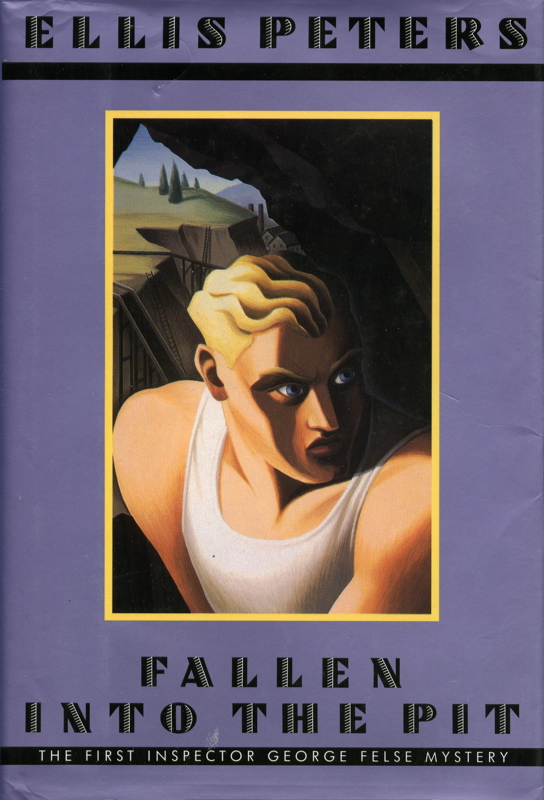
I just finished re-reading an Ellis Peters novel, Fallen Into The Pit. The novel is set in post-World War II England and concerns three murders which take place in the normally sleepy village of Comerford. The solution to the mystery is mostly worked out by the police sergeant's son Dominic Felse, who, frankly, is unconvincingly omniscient for a 13-year-old boy. What I found more compelling than the mystery itself was the way in which Peters (actually Edith Pargeter was her real name) deals with the tough adjustment that World War II vets must have experienced coming home. A few passages to this effect:

“The war ended, and the young men came home, and tried indignantly to fit themselves into old clothes and old habits which proved, on examination, to be both a little threadbare, and on trial to be both cripplingly small for bodies and minds mysteriously grown in absence.” (p. 3)

“…some came haunted by the things their own hand had done and their own bodies endured, growths from which no manner of amputation could divide them, ghosts for which Comerford had no room. They had been where even those nearest to them could not follow, and daily they withdrew there again from the compression and safety of lathe and field and farm, until the adjustment to sanity took place painfully at last, and the compression ceased to bound them, and was felt to be wider than the mad waste in the memory.” (p. 6)

“In time of war countries fall over themselves to make commandos and guerrillas of their young men, self-reliant killers who can slit a throat and live off a hostile countryside as simply as they once caught the morning bus to their various blameless jobs. But to reconvert these formidable creations afterwards is quite another matter. Nobody ever gave much thought to that, nobody ever does until their recoil hits the very system which made and made use of them. Men who have learned to kill as a solution for otherwise insoluble problems in wartime may the more readily revert to it as a solution for other problems as desperate in other conditions. And logically … who has the least right to judge them for it? Surely the system which taught them the art and ethics of murder to save itself has no right at all. The obvious answer would be: ‘Come on in the dock with us!’”(p. 195)


The most tortured of all of Comerford's returning veterans is Chad Wedderburn, whose service with the Yugoslavian rebels is the stuff of village legend. Chad, who is Dominic's school teacher, is very much in love with Io Hart, the daughter of Comerford's widowed tavern owner; Io “could manage the whole diverse flow of customers year in and year out without disarranging a curl of her warm brown hair, and make her father, into the bargain, do whatever she wanted. When she knew what she wanted, which wasn't always.” (p. 48)

But Chad thinks himself too flawed ever to marry Io; “He had suffered, whether by his own fault or the mismanagement of others, injuries to his nature which unfitted him for loving or being loved by an innocent like Io…” (p. 277) Dominic, (too) wise beyond his years, senses Chad’s self-loathing and wonders, “Was it really possible to feel yourself maimed for life, merely because you had been pushed into killing other people in a war in order to stay alive yourself? In a war, when most people thought themselves absolved for everything? But the fellow who goes the opposite way from everyone else isn't necessarily wrong.” (p. 258)

A moment of emergency forces Chad to ask Io for her counsel, and this clears the mist between them. “She did not stop to argue, but did exactly as he asked her; she had been ready to do exactly as he asked her for quite a long time, and the real trouble had been that he had never asked her.” (p. 285) At the end of the novel, the two make a quiet trip to the registry office to become man and wife. We are left to reflect that, in spite of Chad's past and self doubts, really because of them, he was in the end most fitted for loving and being loved by an innocent like Io.

I have often been drawn to fictional characters like Chad Wedderburn, men who are admired by everybody but themselves. Other examples in this motif are the whisky priest in Power and the Glory, the savage in Brave New World, and, above all, Prince Hamlet. If Peters had been a Graham Greene or an Aldous Huxley or a Will Shakespeare, she would have given Chad Wedderburn no relief short of the grave. But instead she took compassion on Chad—and, I suppose, on her readers—and showed instead how the World War II vets actually dealt with their trauma. Having seen enough of hatred, they found wives to love; having seen enough of death, they brought children into the world.

Friday, October 13, 2006

Battleships and Equality


In 1922 the United States, Britain, France, Italy and Japan signed the Five-Power Naval Limitation Treaty. The treaty was intended to limit the number of capital ships (battleships and cruisers) and the number of aircraft carriers the signatory nations could build. The treaty failed to avert a naval arms race, but it does demonstrate an interesting American trademark.

The treaty lists the delegates from the various signatory nations, complete with titles, positions and awards. For example, the French delegation is listed as:
Mr. Albert Sarraut, Deputy, Minister of the Colonies;
Mr. Jules J. Jusserand, Ambassador Extraordinary and Plenipotentiary to the United States of America, Grand Cross of the National Order of the Legion of Honour;


The Italian delgation consisted of:
The Honourable Carlo Schanzer, Senator of the Kingdom;
The Honourable Vittorio Rolandi Ricci, Senator of the Kingdom, His Ambassador Extraordinary and Plenipotentiary at Washington;
The Honourable Luigi Albertini, Senator of the Kingdom;


The British delegation was especially grandiose:
The Right Honourable Arthur James Balfour, O. M., M. P., Lord President of His Privy Council;
The Right Honourable Baron Lee of Fareham, G. B. E., K. C. B., First Lord of His Admiralty;
The Right Honourable Sir Auckland Campbell Geddes, K. C. B., His Ambassador Extraordinary and Plenipotentiary to the United States of America;


And the Japanese delegation was every bit as garish:
Baron Tomosaburo Kato, Minister for the Navy, Junii, a member of the First Class of the Imperial Order of the Grand Cordon of the Rising Sun with the Paulownia Flower;
Baron Kijuro Shidehara, His Ambassador Extraordinary and Plenipotentiary at Washington, Joshii, a member of the First Class of the Imperial Order of the Rising Sun;
Mr. Masanao Hanihara, Vice Minister for Foreign Affairs, Jushii, a member of the Second Class of the Imperial Order of the Rising Sun;


In contrast to all this pomp and ostentation was the simple, egalitarian way in which the Americans were listed:
Charles Evans Hughes,
Henry Cabot Lodge,
Oscar W. Underwood,
Elihu Root,
citizens of the United States;


These men represented a country in which “all men are created equal”. We sometimes forget how distinctive America is. Thank you again, Mr. Jefferson.

Friday, September 15, 2006

Zarqawi and the U.S. Senate


Much has been made of a recent report by the U.S. Senate’s Select Committee on Intelligence which claims there was no link between Saddam Hussein’s regime in Iraq and the terrorist Abu Musab al-Zarqawi.

The Senate report quotes an October 2005 CIA assessment which claims that before the war “the regime did not have a relationship, harbor, or turn a blind eye toward Zarqawi and his associates.” (Reported on page 92 of the Senate report.)

President Bush’s critics have seized upon this as evidence that the President deliberately misled the American people back in 2003 concerning the threat that Iraq posed to the United States.

The problem with this criticism, however, is that it glosses over an inconvenient truth which is spelled out in the same Senate Report: The CIA was singing a different tune in 2002.

Back in September 2002, the CIA reported: “The presence of al-Qa’ida militants on Iraqi soil poses many questions. We are uncertain to what extent Baghdad is actively complicit in this use of its territory by al-Qa’ida operatives for safehaven and transit. Given the pervasive presence of Iraq’s security apparatus , it would be difficult for al-Qa’ida to maintain an active, long-term presence in Iraq without alerting the authorities or without at least their acquiescence.” (Emphasis added.)

This too is reported in the Senate report (on page 89) and clearly indicates that before the war the CIA did think that at the very least Saddam was “turning a blind eye” to Zarqawi.

The significance of this September 2002 CIA assessment is that it exonerates Mr. Bush from the charge that he deliberately misled the American people in 2003 about the relationship between Zarqawi and Hussein. Not surprisingly, the President’s critics have failed to admit this.

Something else which is getting very little play in the national media is the possibility that the Senate committee might very well be mistaken in its assessment that there was no relationship between the two thugs. According to a recent editorial from Investor’s Business Daily, the Senate report “suggests that, at least for the Democrats, Senate intelligence is an oxymoron.”

And on Thursday, the New York Sun reported that Barham Salih, a former Iraqi deputy prime minister, contradicted the Senate report with his assertion that “Some of my friends were murdered by jihadists, by Al Qaeda-affiliated operatives who had been sheltered and assisted by Saddam’s regime.”

Thursday, August 03, 2006

Arbeit macht frei


Elie Wiesel, Night (new translation, 2006)

Perhaps Elie Wiesel is the poet laureate of holocaust survivors. Night is, by his own admission, his most important work. To say the book is powerful is understatement.

The book is Wiesel's memoir of the holocaust, during which he was just a teenage boy. He wrote this book in Yiddish. His wife Marian — “who knows my voice and how to transmit it better than anyone else” (p. xiii) —has recently retranslated it. He uses a very simple and eloquent writing style; the beauty of his prose and the ugliness of his story are perfectly juxtaposed.

Wiesel means to haunt you, and he succeeds. He writes of a tramp in town, dismissed as a madman, who accurately warned of what was to come; of a hysterical lady in the cattle car, dismissed as a madwoman, who had premonitions of all-consuming flames; of his last glimpse of his mother and sister, as they were herded to their deaths at Birkenau the first night; of the sign over the gate at Auschwitz, Arbeit macht frei (“Work makes you free”); of his silence, even relief, the night his father was beaten to death in Buchenwald.


Wiesel felt called to write this memoir in order to make people remember what happened. He won the Nobel Peace Prize in 1986. The volume closes with his acceptance speech, in which he spoke of the sinfulness of remaining aloof:

“We must take sides. Neutrality helps the oppressor, never the victim. Silence encourages the tormentor, never the tormented. Sometimes we must interfere. When human lives are endangered, when human dignity is in jeopardy, national borders and sensitivities become irrelevant. Wherever men and women are persecuted because of their race, religion, or political views, that place must — at that moment — become the center of the universe.” (p. 118-119)

“As long as one dissident is in prison, our freedom will not be true. As long as one child is hungry, our life will be filled with anguish and shame. What all these victims need above all is to know when their voices are stifled we shall lend them ours, that while their freedom depends on ours, the quality of our freedom depends on theirs.” (p. 120)

In one sense, work did make Wiesel free. Because he was given work as a laborer, the Germans never got around to murdering him. The day came when an American tank rattled its way to the gates of Buchenwald, and he was finally free.

But not really free. Not free from the memories. Not free from the sorrow. Not free from the duty of making the world remember.