Our first free travel period has come and gone, and we’ve since made a brief trip to Lucca, Pisa and the Cinque Terre. Yesterday and today have been devoted to classes, but tomorrow we take the train to Naples, with visits to Pompeii and Montecassino scheduled. With some free time this afternoon, I thought I’d try to update the past several days.Thursday, Oct. 13 — I arrived in Paris, after having taken an evening train from Florence to Milan, and an overnight train from Milan to the French capital. With a bit of time on hand before I had to take my next train, I made my way to the Musee d’Orsay, which has several Van Goghs. Sadly, their most famous Van Gogh — Starry Night Over The Rhone — was on loan to Singapore, so I didn’t get to see it. But it was still time well spent. En route to the museum, I found the Parisian “Cleopatra’s Needle.” There are similar Egyptian obelisks in London, Rome and New York.
 I then took the train to Caen, hoping to have enough time to visit the D-Day museum there, but was unable to find it in the relatively short time I had allotted. A bit disappointed, I headed on to Bayeux, where I had stayed for the next three evenings.
Friday, October 14 — My Normandy tour began at about 8:30 Friday morning, with a tour of the British sector, including Pegasus Bridge, and (east to west) Sword, Juno and Gold Beaches. It was interesting, but paled compared to what I would see the next day…
 Saturday, October 15 — Day two of the Normandy tour was the best. It covered the American sector. We began by looking at some German gun emplacements located between Omaha and Gold Beaches.
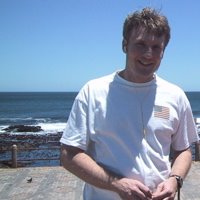
 After leaving the gun emplacements, we went down to Omaha Beach itself, then up to the achingly beautiful American cemetery overlooking the beach, then back down to a different portion (Green sector) of Omaha, at which the picture above was taken. We also went to Pointe du Hoc, the bridge at La Fiere (which I mention in my dissertation), Ste. Mere Eglise, and, of course, Utah Beach.
My biggest disappointment during my stay at Bayeux is that I did not have the opportunity to visit the famous tapestry there. This was not for want of trying. The tapestry museum technically closed at 6:30 each evening, but unfortunately, quit allowing new visitors at 5:45 each evening. (This, in spite of the fact that the museum advertises a strategy for successfully viewing the tapestry if you only have time for a 30-minute visit.) By the time I got around Thursday evening, the museum was already closed. Then on Friday and Saturday, I had my tours of the WWII sites of Normandy, which ended right at 5:45. Most frustrating of all, on Saturday I rushed from the tour to the museum, and was there a little bit before 5:45 (by my watch), but they were still closed, and the lady would not open the door, in spite of me begging her to do so.
Sunday, October 16 — Sunday was a travel day. Since I wanted to catch the 7:42 train from Caen to Paris, and since there was not a train from Bayeux to Caen that ran early enough for me to do so, I had to take a taxi from Bayeux to Caen instead. That ran me to just shy of 75 Euros, but it allowed me to catch that train to Paris. I even had the opportunity to attend worship services with the church of Christ at 4, rue Déodat de Séverac — though it was, of course, in French. I then returned to the train station and made reservations for the train to Munich later in the afternoon. This was an even worse financial jolt. Even though I have a pass which is supposed to allow me to travel “free” (even still, I sometimes have to pay small reservation fees), they were not letting me use it on the portion of the journey from Paris to Stuttgart, so I had to buy a regular ticket — and a first class one, at that — for 185 Euros. The reservation from Stuttgart into Munich was, thankfully, just 3 additional Euros. With a considerably lighter wallet (actually, a considerably heavier credit card bill), I boarded the train for Munich, and arrived with no problems.
Monday, October 17 — Monday morning I boarded the train from Munich to Berchtesgaden, where I took a fascinating tour of Obersalzberg Mountain, which included a visit to Hiter’s famous “Eagle’s Nest” retreat. Since Hitler was both (A) afraid of heights, and (B) afraid of tight spaces; and since the Eagle’s Nest is (C) really, really high up in the mountains, and (D) accessible only by an elevator, he actually didn’t like going to the little Alpine retreat very much, and seldom used it. He and other high-ranking Nazi officials, including Herman Göring, had residences lower down Obersalzberg Mountain, which were largely destroyed by an Allied bombing raid during the war, and then blown up again after the war for good measure.
 Tuesday, October 18 — After spending Monday evening in Berchtesgaden, Tuesday was another travel day, this time all the way back to Florence. After wandering around Europe alone, it was really good to see all my students again.
Wednesday, October 19 — Even though there was some sentiment among my students that they should be able to rest up from their six consecutive days of not having classes by also not having class Wednesday morning, tyrannical dictator that I am (perhaps my visit to the Eagle’s Nest had rubbed off on me), I insisted that we start back at it at 8 in the morning, which we did. We had chapel in the afternoon. That evening, Robbie took me to an interesting presentation by a British WWII vet named Frank Unwin who had been imprisoned in Italy during the war, escaped, was recaptured, and brought to Florence. He is still sharp, and it was a joy to hear his story.
Thursday, October 20 — Another day of classes. I also spoke in chapel, using one of Dad’s devotionals (“Dealings With Life’s Second Bests”), drawn from Acts 16.10, and contained in the More Strength for the Journey book.
Friday, October 21 — We headed out on a two-night trip. Our first stop was the walled town of Lucca, followed by a visit to Pisa (including, for many of us, climbing the Leaning Tower; see the picture of “Pisa Team One” below).
 We then traveled by train to the Cinque Terre, the five places, a group of five fishing villages along the Lingurian Sea (itself a portion of the larger Mediterranean). We stayed two nights in hotels at Vernazza, one of the five villages. After eating at a wonderful restaurant, we made our way to a pile of rocks in the bay, where we sang hymns in the night.
 Saturday, October 22 — In the morning, we explored more of the Cinque Terre, through a combination of train rides and walking the trail. It is beautiful country; the little villages cling to the hillsides, and have little roads winding through their houses and shops. The picture below is also of Vernazza.
 Sunday, October 23 — We made it back to Florence by train, and had worship together in the villa Sunday evening. After spending the previous Lord’s Day in Paris, trying to sing songs I did not much understand, it was a blessing to spend this Lord’s Day (evening) singing in English!
Monday, October 24 — Classes again. Robbie allowed me to guest lecture his humanities class on the subject of Italy during World War II. I informed my eight American History students that this class also counted as an American History lecture, as well.
Tuesday, October 25 — More classes. I tested my American History students, but, by updating my blog, have managed to avoid grading the tests thus far, at least. We have a pizza dinner scheduled in a little bit. Then tomorrow, Lord willing, it will be on to Naples.